Impact of the Middle East Conflict on Cargo Movements
Fragile Maritime Routes and Rising Global Trade Pressure
The escalating conflict in the Middle East and renewed risks in the Red Sea are once again disrupting global trade. With cargo stranded at sea, in ports, and across congested hubs, the situation highlights the extreme fragility of key maritime routes.
As major container lines avoid the Red Sea, the Suez Canal, and the Strait of Hormuz — a critical choke point for global energy and cargo — vessels are being diverted onto much longer voyages around the Cape of Good Hope. These diversions are absorbing global shipping capacity and extending transit times by weeks.
Insights from Mr. Krishnakumar Nair
According to Mr. Krishnakumar Nair, Founder & Chairman of Kenshine Group, the impact is forcing a pragmatic rethink of global supply chains.
“The rerouting is driving up costs through emergency war-risk and conflict surcharges, while shippers face delayed deliveries and significant working capital tied up on the water. This situation is forcing companies to rapidly build more resilient supply chains that rely less on a small number of strategic passages vulnerable to sudden geopolitical disruption,” says Mr. Nair.
His views have also been featured across leading trade and business media, including The New Indian Express, India Seatrade News, and EXIM India where he highlighted the pressure created by war-risk surcharges, vessel diversions, reforwarding costs and delayed cargo movement.
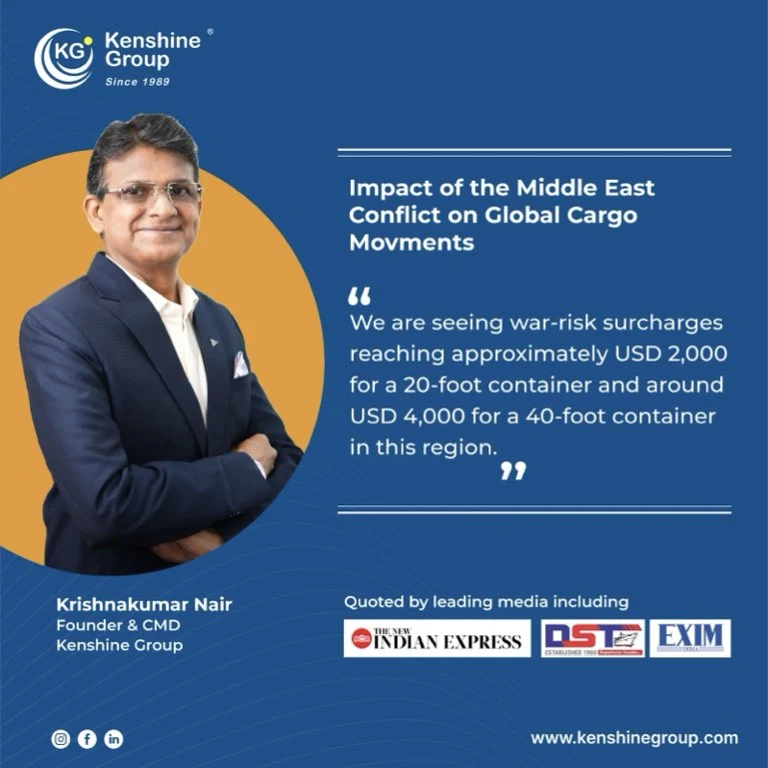
In recent media coverage, Mr. Nair noted that war-risk surcharges were reaching around USD 2,000 for a 20-foot container and around USD 4,000 for a 40-foot container. He also highlighted that if vessels are forced to reroute around the Cape of Good Hope instead of using traditional Gulf or Suez-linked corridors, exporters could see logistics costs rise by roughly 25–40%, depending on routing and cargo profile.
The Financial Burden: War-Risk and Conflict Surcharges
The most immediate impact for Indian traders has been the introduction of exponential surcharges.
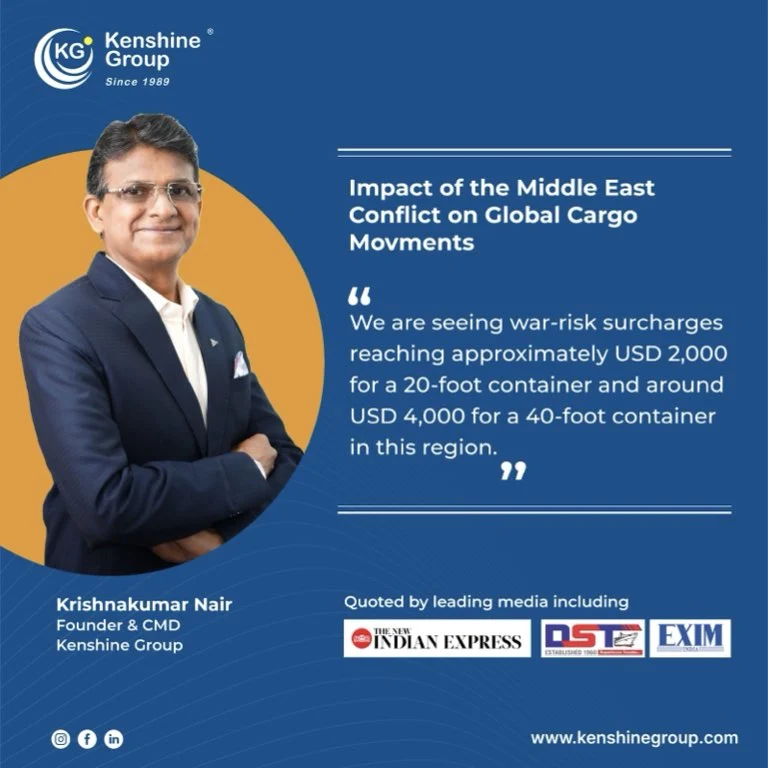
“We are seeing war-risk surcharges reaching approximately USD 2,000 for a 20-foot container and around USD 4,000 for a 40-foot container. In many cases, these surcharges are several times higher than the standard freight rates previously seen on India-Middle East routes,” Mr. Nair explains.
These additional costs are not limited to ocean freight alone. Exporters and importers are also facing increased costs linked to re-routing, reforwarding, demurrage, storage, equipment imbalance and longer transit cycles.
Impact on Local Cargo Movement and Port Storage
Regional instability has brought local operations within these sectors to a near-halt.
“For cargo that has already reached the ports, storage is reaching capacity. Soon, the cargo will have to be moved from port warehouses and offloaded to private warehouses near the port premises. This trend will continue until clarity arises and shipment bookings to these sectors commence again,” Mr. Nair adds.
This creates an additional challenge for exporters and importers who may already be facing delayed vessel schedules, uncertain booking acceptance, higher storage exposure and working capital pressure.
Strategic Shifts and Alternative Routing
To mitigate the potential closure of the Strait of Hormuz, Kenshine Group is actively exploring alternative gateways.
“The industry is looking at options like Khorfakkan Port to bypass the Strait for FCL movements. We are currently evaluating the feasibility of these routes to ensure cargo movement continuity,” Mr. Nair stated.
The logistics industry is also closely monitoring vessel routing decisions, carrier advisories, surcharge announcements and transshipment hub congestion. For Indian exporters, alternate routing is no longer only a contingency measure; it has become a key part of supply chain risk planning.
Government Monitoring and Industry Engagement
In response, India’s Commerce Ministry has formed a special Inter-Ministerial Group for Supply Chain Resilience. This group is expected to ensure coordination between the Ministries of External Affairs, Shipping, and Petroleum.
“The government’s move to establish this group is a positive step. It indicates that authorities are prepared to provide the procedural flexibility needed if disruptions intensify,” Mr. Nair concluded.
What This Means for Exporters and Importers
The Middle East conflict is a reminder that global trade routes are deeply interconnected and highly sensitive to geopolitical disruptions. For exporters and importers, the current situation reinforces the need for:
- Proactive shipment planning
- Alternate routing options
- Real-time freight and surcharge monitoring
- Strong documentation preparedness
- Flexible supply chain and inventory planning
- Reliable freight forwarding and customs clearance support
At Kenshine Group, we continue to monitor the situation closely and support customers with practical logistics solutions, alternate route evaluation, freight planning, customs clearance coordination and cargo movement continuity.
Conclusion
The ongoing disruptions across the Middle East, Red Sea, Suez Canal and Strait of Hormuz region have created significant pressure on freight rates, transit times and global cargo movement.
While the situation remains fluid, the key lesson is clear: businesses must build resilient supply chains that are not overly dependent on a limited number of vulnerable trade corridors. With the right logistics partner, exporters and importers can better navigate uncertainty, control cost exposure and maintain continuity in cargo movement.
Kenshine Group remains committed to supporting Indian trade with reliable freight forwarding, customs clearance, LCL consolidation and multimodal logistics solutions.